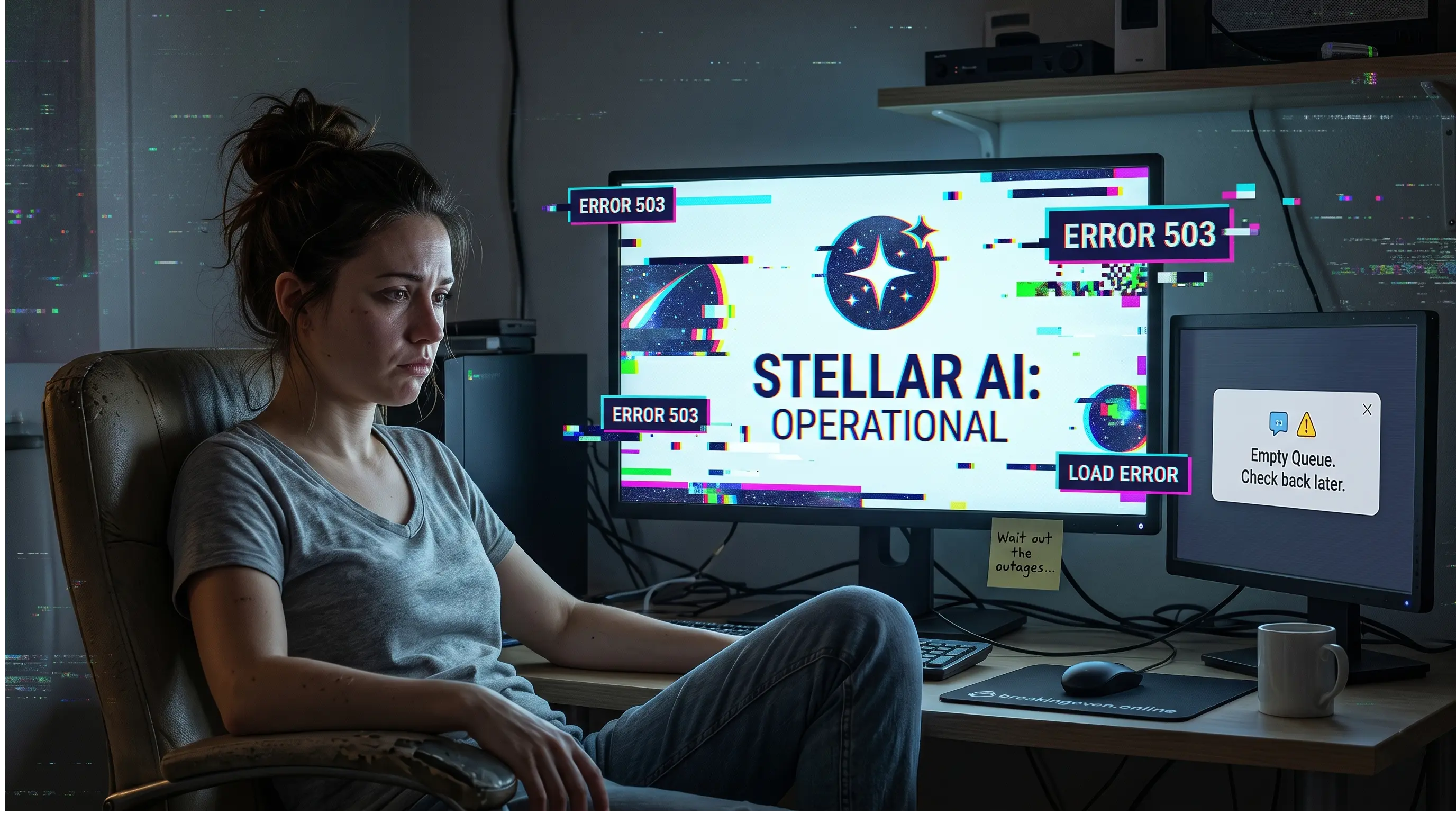
Stellar AI Review 2026: The Platform Has Closed
Update, October 28, 2026: Stellar AI is closed. The company posted its permanent shutdown on October 10, 2026, and sent closure emails to workers through the rest of the month. A subset of people got a targeted goodbye note that mentioned a possible future opportunity. Most got nothing. There is no work, no queue and no application. The review below stays up as a record of what the platform was, because I worked there and because the bar Stellar set is still the right bar to hold every other platform to.
What Happened
Stellar did not blow up. It wound down.
Workers who had been there for years describe solid, reliable work from around December 2025 through June 2026, then a collapse in availability that never reversed. Through the late summer the platform was still running qualification tests for projects that never arrived, so people kept qualifying for work that was already gone. One worker put it plainly: qualified for one project, paused before a single task, qualified for another, paused before a single task. By September the common read was that the place was dormant and nobody would say so out loud.
Then on October 10 the company said it directly.
What came next is the part that makes this closure different. The threads were not angry. They were sad. People thanked the platform. A reviewer of two years said they were emotional about it. Someone wrote that it is a sign of the times that the one decent platform in this space is the one that closed, while the ones that treat workers badly carry on. At least two workers posted about losing something closer to an anchor than a gig, and those posts are hard to read.
Hold that next to the rest of the industry for a second. Workers spend their days on platforms that ban them by algorithm with no appeal, convert hourly contracts to pay per task after onboarding, and accuse them of using an LLM to avoid paying out a balance. Stellar paid weekly, paid on time, paid for broken tasks, and answered its support tickets. It is the one that is gone.
The lesson is not a nice one. Being good to workers is not what keeps a platform alive in this market. Having clients is. Stellar ran out of clients.
What It Paid
Stellar AI is one of those platforms that existed just outside the main conversation. You did not hear about it constantly the way you hear about Outlier AI eating your soul or DataAnnotation's bilingual workers quietly making $47/hour. It was there. Workers were on it. In the last year of its life the experience was a mixed bag with a technical instability problem nobody warned anyone about.
Here is what the data said while it ran, what the pay looked like, and what to take from it now that the platform is gone.
The Last Score: 48/100, Trending Down
The breakingeven.online sentiment dashboard had Stellar AI at 48 out of 100 before the closure. That is the midpoint, not terrible, not good. The status read Operational, meaning the platform was running and payments were going out. But the trend was down, and the top issues workers flagged were:
- Technical issues (the dominant theme)
- Empty queue
The technical instability is specific: seven posts in the current analysis window report loading errors, site outages, or broken project pages. That's not a user error pattern. That's a platform that isn't 100% stable.
When you're doing AI training work, technical instability costs you in two ways. First, the obvious one: you can't work when the platform is down. Second, the less obvious one: if you're in the middle of a task and the page breaks, you lose your work. There's no autosave on most of these platforms, and Stellar AI appears to be no exception. The saving grace: this has happened to me a few times and I didn't lose everything, and Stellar pays you for the time anyway, which softens the blow.
Pay: $18–$44 Per Hour
The reported pay range on Stellar AI is $18–$44/hour, with an average around $21/hour. I have never personally seen a number on the lower end — not to say they aren't there, just an FYI. That puts it in line with the other B-tier and higher platforms:
- DataAnnotation ($28–$65/hr)
- Outlier AI ($15–$50/hr reported)
- Handshake AI ($17–$100/hr)
- Babel Audio ($50/hr — overlaps at the high end)
- Mindrift ($20–$45/hr — overlaps significantly)
Well above Telus AI ($10–$30/hr).
The $18–$44 range is a decent amount if you are treating this as extra, like you should be. If it has crept its way in as your main employment, keep looking for a real job with benefits — this could help out until you do, if there's work to be done. For data annotation and AI training tasks at that rate, you're trading time for a lower ceiling than most other platforms in this space currently offer.
The "actively hiring" keyword shows up in community discussions alongside the empty queue reports, which is the contradiction that defines AI gig work in 2026. The platform is marketing itself as hiring while workers report sitting in empty queues. This isn't unique to Stellar AI — it's standard operating practice of every platform I have ever been on — but it's worth naming, because standard practice should not simply be dismissed as normal. It should be called attention to, because standard does not always equal right.
What Workers Are Saying
The technical issues discussion is the thread you'd want to read before committing significant time to the platform. Know the risks. And if you commit, find ways to mitigate them. Workers report:
- Loading errors on the task dashboard — pages that fail to load or hang
- Site outages — periods where the platform simply isn't accessible
- Broken project pages — tasks that exist in the system but can't be opened
If you've worked on other AI training platforms, you've probably seen some version of this. But seven separate posts calling it out in a 52-post sample is a signal worth taking seriously. That's 13% of the conversation about things not working correctly on a platform.
The empty queue problem is the other persistent theme. Workers showing up and finding no tasks available. This is a function of how AI training work is distributed — the platform has batches of work that come and go, and the queue between batches can sit empty for days.
With Stellar AI specifically, when people are discussing empty queues they could be talking about different things unknowingly. When you finish a piece of work and hit submit, it will either take you to the next item or confetti will blow and tell you you are done for the day. Your queue goes empty and that piece of work is sent in for review. While in review, you won't be able to access the forum or new work until they are finished. If you do have work in review, you can see it in your Messages and Notifications folders — there it will show the project and status as pending staff approval. Other folks just have no work. Whether that's due to a project ending or poor quality, I cannot say. That last part is not a Stellar AI-specific problem, but if you're counting on consistent hours, you need to know it happens here too. It always comes back to eggs|basket.
What Stellar AI Actually Is
For anyone unfamiliar: Stellar AI is an AI data platform that sources training data from human workers, primarily through annotation tasks, evaluation tasks, and RLHF (Reinforcement Learning from Human Feedback) work. The work itself is similar to what you'd find on DataAnnotation, Outlier, or Alignerr — reviewing AI outputs, rating responses, labeling data, writing prompts.
The platform has positioned itself as a more accessible entry point, which tracks with the lower pay ceiling relative to specialized platforms. You don't need domain expertise to get started — but if you do, you can get projects that pay more.
The hiring status is currently marked Active, which means the platform is taking new worker applications. If you're building a portfolio of platforms, adding Stellar AI when you're accepted is reasonable. Be prepared to wait though. It was months after I applied that I got my first offer. It was a good paying project, but the assessment for that project was brutal and took me a very, very long time to complete. The bonus if you were accepted covered my time, but there's always a risk that you might not get on, which means time lost.
Who It Was For, While It Lasted
This is the section that used to tell you whether to add Stellar to your rotation. It is kept because the shape of the answer is still useful when you are sizing up a platform that is still open.
It worked for you if:
- You were early in this work and building experience across several platforms
- You had the time to wait out the empty queues and the technical outages
- You treated it as one of four or five platforms in rotation, never a primary income source
- You could absorb the technical instability without it wrecking your effective hourly rate
It did not work for you if:
- You were coming off Outlier's Aether wind-down and needed to replace $50/hr work that week
- Your time was limited and you could not afford to lose hours to loading errors
I read the technical problems at the time as growing pains from a platform scaling faster than its infrastructure. That read was wrong in one specific way. The instability was not a platform scaling up. It was a platform running short of the client contracts that paid for the thing.
The Comparison Context
The comparisons below are from when Stellar was open. They stay because they are a snapshot of where the market sat in 2026, not because any of them is a live recommendation.
Stellar AI vs. Mindrift: Mindrift was trending up at 55/100, recovered from Warning to Operational. Pay ranges overlapped, with Mindrift reaching slightly higher at a $45/hr ceiling against Stellar's $44.
Stellar AI vs. DataAnnotation: No contest if you qualified for DataAnnotation's better tasks. The bilingual specialist premium at DataAnnotation pushes $65/hr. Stellar AI's ceiling was $44.
Stellar AI vs. Telus AI: Stellar had the better pay potential, $44 against Telus at $30. Telus had a higher account ban rate, 9.6 percent against Stellar's 3.8 percent, and a worse empty queue problem, 17.3 percent of posts against Stellar's 5.8 percent. Technical instability was Stellar's deficit. Availability and account stability were Telus's.
Where This Lands
Stellar AI paid weekly, paid on time, paid you for work a broken page ate, and answered when you wrote in. It closed anyway, on October 10, 2026.
Two things to take from it.
The first is the one this site has said from the start. Never solo-platform. People who treated Stellar as their safety net found out in October that a safety net can close too. Keep two or three live at all times, and treat every dollar from any of them as extra.
The second is harder. The platform that treated workers best is the one that is gone, and the ones running automated bans with no appeal are still here. Do not read a platform's decency as a sign it will last, and do not read a platform's size as a sign it will treat you well. Those are two separate facts, and you have to track both.
See the platform tier list for where everything still running currently sits, and what happens when the work stops if the queue you depend on just went quiet.
Pay and sentiment figures are from the breakingeven.online pipeline while Stellar AI was operating. Posts analyzed: 52. Last sentiment score before closure: 48/100. Closure announced 2026-10-10; page updated 2026-10-28.
Everything we track on Stellar AI: pay, reviews, and how to apply
Read Next
From the community
Join the conversation — no email needed →What workers are talking about
Comments
Leave a comment
Joshua Drake has worked on AI training platforms for over four years, tracking earnings, sentiment data, and platform stability across Outlier, DataAnnotation, Alignerr, and others. He has a degree in data analytics and runs this site, breakingeven.online and the sentiment analysis used to derive a sense of what is happening in a world often hiding in the shadows.